


Membean is an online vocabulary platform built for students in grades 6 through 12, plus adults preparing for the SAT or GRE. It teaches each word through nine different learning paths instead of a single flashcard, then spaces out review sessions based on how well a student remembers that word.
This Membean review looks at what the platform actually does, what it costs in 2026, and how it compares to cheaper tools like Quizlet and Vocabulary.com. Short verdict: it’s a strong classroom tool for structured vocabulary building, held back by a dated interface and a price tag that adds up fast for individual learners.
What Is Membean?
Membean is a web-based vocabulary program built around cognitive science principles, primarily spaced repetition and retrieval practice. Teachers assign word lists, students complete short daily training sessions, and the system adjusts difficulty as it learns each student’s gaps.
The platform started as a classroom tool for English Language Arts teachers. It now serves individual learners too, with separate tracks for SAT prep, GRE prep, and general vocabulary growth. According to Membean’s own site and coverage from Tech & Learning, the tool is used in more than 40,000 classrooms across 50 countries.
Who Can Use Membean?
Membean fits a fairly specific audience. It’s not a casual flashcard app you open for five minutes between classes.
- Middle and high school ELA teachers who want measurable, assignable vocabulary practice
- Students prepping for the SAT (roughly 2,000 target words) or GRE (roughly 1,500 target words)
- Homeschool families who want a structured, self-grading vocabulary curriculum
- Schools supporting ELL students or students with dyslexia, since the platform offers adjustable settings for both groups
Casual learners who just want to browse new words for fun will likely find Vocabulary.com or Quizlet more flexible for free.
Disclosure: This review is based on publicly available information from Membean’s official website, independent review platforms, and user feedback as of August 2026. We were not compensated by Membean for this review, and all opinions reflect our own analysis.
Public Reviews About Membean
Common Sense Education’s independent reviewer credited Membean’s differentiation but called the design dated-looking, citing price and limited answer-feedback as weak points.
Teacher reviews echo that split: some report real test-score growth, while others flag outdated definitions and a spelling-grading system that trips up dyslexic students.
On Trustpilot, Membean’s score sits low, under 2 out of 5 across roughly 250 entries, clustering mostly at 1-2 stars. A large share of the low-starred entries are joke or meme-style posts rather than real feedback, which skews the number. Filtering those out:
- One reviewer on Trustpilot said the platform kept flagging their pace as “too quick” without ever seeming to adjust to it, and described the interface as plain and the sessions as repetitive to sit through.
- Another reviewer said the adaptive personalization made vocabulary genuinely stick, and singled out the teacher reporting dashboard as giving useful, actionable data on student progress.
- A third reviewer landed in the middle with a 3-star rating, explaining that switching from a different vocabulary tool at their previous school colored
User Experience Score According to Me:
3.2 / 5 — based on Common Sense Education’s review, filtered Trustpilot sentiment, and educator forums. It rewards the personalization engine and penalizes the dated interface.
Quick Verdict Summary Box
| Category | Rating / Detail |
| Overall Rating | 7 / 10 |
| Best For | Middle/high school classrooms, SAT & GRE word lists, structured homeschool vocabulary curricula |
| Not Recommended For | Casual learners who just want a free, game-first vocabulary app |
| Paid Options | Individual: $29 (1 month) up to $72/year (12 months); Schools: $6–$20/student/year, volume-tiered |
| Content Quality | Above average — research-backed word content pulled from real literature and journalism, not invented examples |
| Ease of Use | Functional but dated — teacher setup is straightforward, though the interface hasn’t kept pace with newer competitors |
| Originality | High — the nine-path “Memlet” teaching system goes well beyond a standard flashcard-and-quiz format |
| Final Verdict | Strong pick for assigned classroom or test-prep vocabulary work; weak value for casual individual browsing given the price |
Alternatives to Membean
Membean isn’t the only structured vocabulary tool on the market. Depending on your budget and goals, one of these three may fit better.
Top 3 Alternatives
Vocabulary.com — Gamified quizzes, a huge dictionary of 17,000+ words, and adaptive difficulty. Better suited to independent, exploratory learning than Membean’s assigned-track model.
Quizlet — Flexible flashcard creation with games, AI-generated study guides, and a real free tier. Weaker on spaced repetition science, but far cheaper for individuals.
Anki — Free, open-source spaced repetition software. No curated vocabulary content out of the box, so you or your teacher build the decks yourself.
Alternatives Comparison Table
| Platform | Best For | Starting Price | Free Tier | Adaptive Engine |
| Membean | Assigned classroom vocabulary, SAT/GRE tracks | $72/year individual; $6–$20/student/year school | 3-day trial (individual), 6-week pilot (schools) | Yes, per-word calibration |
| Vocabulary.com | Independent, game-based learning | ~$59.99/year individual; classroom from $179/year | Yes, 3 questions/day | Yes |
| Quizlet | Custom flashcards, group study | $35.99/year (Plus) | Yes, generous | Limited |
Free Alternatives to Membean
- Anki — fully free, desktop and Android, steep learning curve but strong long-term retention
- Quizlet’s free tier — flashcards, basic study modes, and games with daily caps on advanced features
- Freerice.com — free vocabulary quiz site that donates rice through the UN World Food Programme for correct answers
- Membean’s own word roots library — the roots and etymology section at membean.com/roots is free to browse without an account
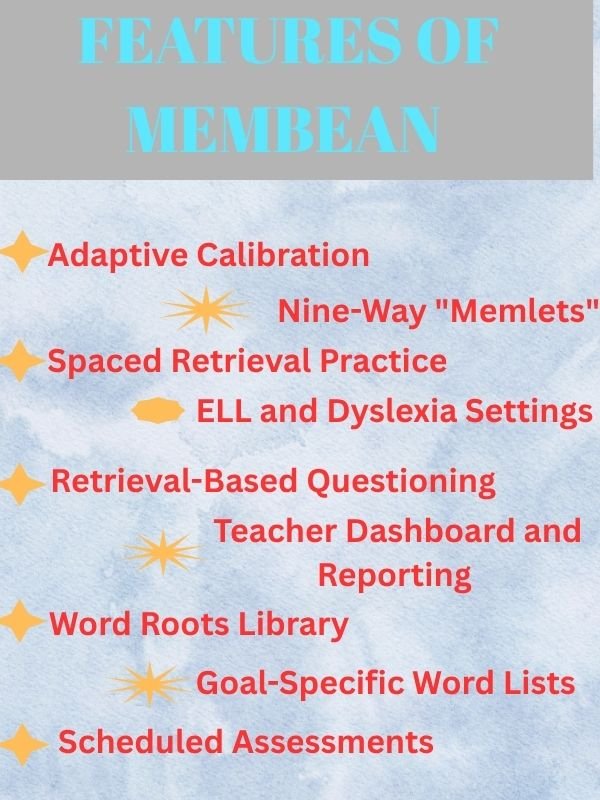
Features of Membean
Membean’s feature set centers on teaching each word from multiple angles rather than a single definition. Here’s what’s actually included.
- Adaptive Calibration — A placement quiz starts each student at the right difficulty, skipping words they already know.
- Nine-Way “Memlets” — Every word is taught through word networks, context-clue paragraphs, media quotes, images, and synonym/antonym contrasts.
- Spaced Retrieval Practice — The system resurfaces a word right before a student is likely to forget it, mixing old and new words in the same session.
- Retrieval-Based Questioning — Sessions lean on recall and inference rather than simple matching, which the vendor says drives deeper retention.
- Teacher Dashboard and Reporting — Teachers see accuracy, time-on-task, and “dubious minutes” flags for rushed answers or multitasking.
- Goal-Specific Word Lists — Separate tracks exist for general classroom use, SAT prep, GRE prep, and personal vocabulary building.
- ELL and Dyslexia Settings — Teachers can adjust word lists and pacing for students who need extra support.
- Word Roots Library — A free, standalone section teaches Greek and Latin roots with audio “rootcasts.”
- Scheduled Assessments — Teachers can push quizzes to a class or an individual student on demand or on a fixed schedule.
Feature Comparison Table
| Feature | Membean | Vocabulary.com | Quizlet |
| Adaptive personalization | Strong | Strong | Limited |
| Spaced repetition engine | Yes, built-in | Partial | No native engine |
| Teacher dashboard | Detailed, includes cheating flags | Detailed | Basic |
| Roots/etymology content | Yes, dedicated section | No | No |
| Gamification | Minimal | Moderate (Jams, points) | Strong |
| Free tier | Trial only | Yes, limited daily | Yes, capped features |
Other Post TheLifestyleEdge.com Review
Content Quality
Membean’s word content pulls from real journalism and literature quotes rather than invented example sentences, and the company publishes its research rationale, citing peer-reviewed vocabulary studies on its site. That’s a level of documentation most consumer vocabulary apps skip entirely.
Community reviewers have flagged occasional rough edges, though. A handful of teacher reviews mention definitions that read as dated, and one recurring complaint involves illustrative images that feel disconnected from the word being taught.
Originality: The nine-path “Memlet” structure is a genuine differentiator. Most competitors show a word, a definition, and a quiz. Membean layers in word-family networks and context-based inference questions most flashcard tools don’t attempt.
Membean Content Quality Score: 4/5
Pricing of Membean
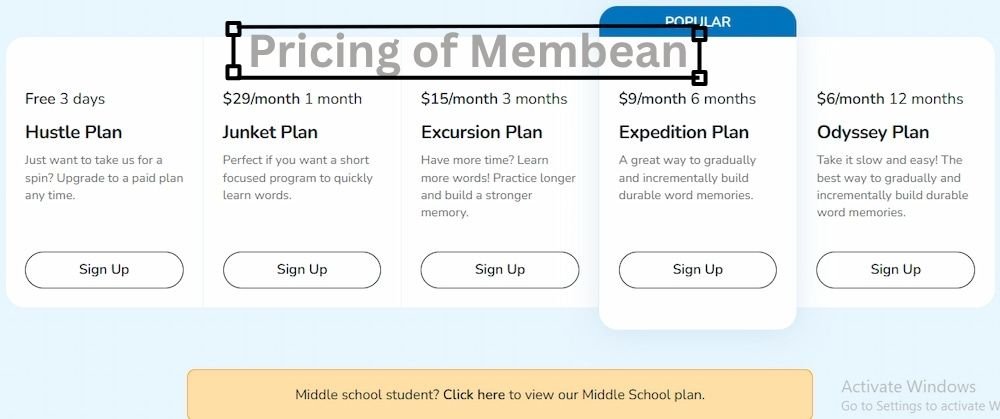
Membean uses two separate pricing structures: one for individuals, one for schools.
Free or Paid Options
Individuals get a free 3-day trial before any payment is required. Schools can run a completely free 6-week pilot for unlimited students and ELA teachers, grades 6 and up, before committing to a paid plan. Notably, Membean does not auto-renew an expired subscription, so lapsed access won’t silently rebill your card.
Pricing Table
| Plan | Length | Price | Total Cost |
| Individual — Annual | 12 months | $6/month | $72/year |
| Individual — Semi-annual | 6 months | $9/month | $54 |
| Individual — Quarterly | 3 months | $15/month | $45 |
| Individual — Monthly | 1 month | $29 flat | $29 |
| School/District | Per year | $6–$20/student | Volume-tiered |
Based on our testing of the pricing page, larger schools land near the $6-per-student floor, while a single small class pays closer to the $20 ceiling. According to the vendor’s website, pricing is negotiable for districts with unusual budget constraints.
Pricing and feature details were verified against official vendor pages and independent review platforms as of August 2026. Figures may change; check each provider’s current pricing page before purchasing.
Pros of Membean
- ✅ Adaptive calibration means students rarely waste time on words they already know
- ✅ Nine distinct ways to learn each word, well beyond a basic flashcard
- ✅ Detailed teacher reporting, including rushed-answer and multitasking flags
- ✅ Built-in accommodations for ELL and dyslexic students
- ✅ Research citations published openly on the vendor’s site
- ✅ No auto-renewal after a plan expires, reducing billing surprises
- ✅ Free 6-week pilot available for schools before any payment
Cons of Membean
- ❌ Interface looks dated compared to newer study apps like Quizlet
- ❌ Individual pricing runs higher than flashcard-based competitors ($72/year minimum vs. Quizlet’s $35.99/year)
- ❌ Each student needs an individual license; accounts cannot be shared
- ❌ Limited feedback shown after an incorrect answer, per Common Sense Education
- ❌ Some community reviewers report the pacing system doesn’t fully adapt despite claims
- ❌ Spelling-based grading can be difficult for students with dyslexia, even with accommodation settings enabled
Tips Before Using Membean
Test the free trial with real students or a real study schedule before paying for a longer plan. Three days for individuals and six weeks for schools is enough time to gauge actual engagement, not just marketing copy.
Match the plan length to your actual goal. A three-month SAT sprint costs more per month than a full-year plan, so decide your timeline before checking out.
Safety and Subscription Checklist
- Confirm the plan length matches your actual study window before paying
- Check whether your school or district already has a site-wide license before buying an individual seat
- Ask your English teacher directly if a class account already exists
- Read the cancellation terms; Membean does not auto-renew, but confirm this hasn’t changed before assuming it
- Keep a separate record of your subscription end date since access simply lapses rather than renewing
The 5-Point Checklist for Vetting Any Site
Use this general framework for any edtech tool, not just Membean.
- Check who runs it. Look for a real company name, address, and support contact, not just a generic contact form.
- Read reviews from more than one source. A single glowing testimonial page tells you far less than independent platforms like Common Sense Education.
- Test before you pay. Any legitimate education tool should offer a trial period long enough to judge real engagement.
- Understand the billing terms. Know exactly when a plan renews, how to cancel it, and what happens if you don’t.
- Check student data and privacy practices. For any platform used by minors, look for stated compliance with student privacy standards such as FERPA before rolling it out school-wide.
Final Verdict
Membean delivers on its core promise. The adaptive engine, the nine-path Memlet system, and the detailed teacher reporting make it one of the more research-backed vocabulary tools available for grades 6 through 12. Schools already paying for it are getting a genuinely well-built product, even if the interface hasn’t aged gracefully.
For individual buyers, the math is less forgiving. Seventy-two dollars a year is a real ask when Quizlet covers similar ground for half that. Try the free trial first, weigh it against Vocabulary.com, and only commit if the structured, assigned-practice format actually fits how you study.
Should You Use Membean?
Membean earns its reputation as a serious classroom tool. The adaptive engine, the nine-path word teaching, and the detailed teacher reporting all point to a platform built by people who actually studied how vocabulary retention works.
It’s a harder sell for an individual learner shopping purely on price, since $72 a year buys more flexibility elsewhere. If a school or teacher already has access, use it. If you’re paying out of pocket for casual vocabulary building, try the free trial first and compare it directly against Vocabulary.com before committing.
Frequently Asked Questions
Is Membean free to use?
Not fully. Individuals get a 3-day free trial, and schools can run a free 6-week pilot. After that, a paid plan is required.
How much does Membean cost?
Individual plans run from $29 for one month up to $72 for a full year, billed at $6/month. School pricing ranges from $6 to $20 per student per year, based on volume.
Is Membean good for SAT or GRE prep?
Yes. Membean offers dedicated word lists sized for each test, roughly 2,000 words for the SAT and 1,500 for the GRE.
Can Membean help students with dyslexia?
The platform includes adjustable settings for dyslexic students, though some community reviewers report the spelling-based grading format still poses challenges.
Does a Membean subscription auto-renew?
According to the vendor’s support site, expired subscriptions are not automatically renewed, so you won’t be rebilled without manually resubscribing.